Band · United States
The Monks
Sixties US group, famed for early use of feedback
Formed in 1964
Listen
Follow
Upcoming shows
No upcoming dates yet.
Tour dates elsewhere: Songkick
About
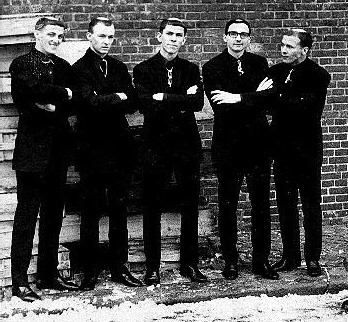
The Monks (also known as Monks), were an American rock band formed in Gelnhausen, West Germany, in 1964. Assembled by five American GIs stationed in the country, the group grew tired of the traditional format of rock, which motivated them to forge a highly experimental style characterized by an emphasis on rhythm over melody, augmented by a heavy use of distortion.
The band blended shrill vocals, anti-Vietnam war lyrics, guitar feedback, and a six-string banjo into a sound that music critics later recognized as prefiguring the punk rock movement. The band's appearance was considered as shocking as their music, mimicking the look of Catholic monks by wearing black habits, cinctures, and styling medieval tonsure haircuts. Local newspapers at the time labelled the band "the anti-Beatles". In March 1966, they released their sole studio album, Black Monk Time, via Polydor Records, with the help of a German management team, alongside their single "Complication" backed with "Oh, How to Do Now". However, the album and additional singles issued throughout 1966 and 1967 achieved limited success which led to the group disbanding.
During the 1990s to early 2000s, the band acquired a cult following as a result of newfound interest in Black Monk Time. They were subsequently featured on several compilation albums, most notably the 1998 expanded version of Nuggets. This resurgence was followed by all five of the original band members holding a reunion concert at the Cavestomp festival in New York City on November 5, 1999, which was followed by sporadic touring in the 2000s. They have been cited as an influence by notable artists such as Jello Biafra, Jay Reatard, Mark E. Smith, Lenny Kaye, Krist Novoselic, Ira Kaplan, Jack White, Jon Spencer, Iggy Pop, and the Beastie Boys.
From Wikipedia, CC BY-SA 4.0.
Also in Français
The Monks est un groupe américain de garage rock, originaire de Gelnhausen, en Allemagne de l'Ouest. Gary Burger, Dave Day, Eddie Shaw, Larry Clark et Roger Johnston, sont à l’origine cinq GI américains basés à Gelnhausen en 1963. Après leur sortie de l’armée, ils restent en Allemagne où ils forment un groupe d’abord appelé The Torquays, puis The Monks, et jouent sur les scènes locales, notamment à l’Odéon Keller à Heidelberg.
Ils enregistrent et sortent en 1966, chez Polydor Allemagne, l'album Black Monk Time qui contient 12 titres où les rythmes tribaux et les riffs agressifs font bon ménage avec le banjo à six cordes de Dave Day. Ils adoptent une image de circonstance : entièrement habillés de noir avec une corde nouée autour du cou, complétée, comme le nom du groupe l’exige, par une tonsure de moine. Ils continuent de tourner dans les clubs locaux, acquérant un groupe de fans fidèles qui n’hésitent pas adopter leur coiffure et à se vêtir de capes noires.
Après deux ans sans succès réel, ils décident de se séparer juste avant une tournée prévue au Viêt Nam, alors en pleine guerre, et rentrent aux États-Unis. En 1994, la maison de disques Infinite Zero ressort leur album de 1966 en CD aux États-Unis et un renouveau d’intérêt pour le groupe se développe. Ils décident alors de se reformer pour quelques concerts en 1999. En 2006, ils font l'objet du documentaire Monks: The Transatlantic Feedback, accompagné d'un album de reprises, Silver Monk Time.
Wikipedia, CC BY-SA 4.0
Discography
Albums
- 1966 Black Monk Time


