Band · France
Gong
progressive/psychedelic rock band
Formed in 1966
Listen
Follow
Upcoming shows
- Montreuil, France · Bal Chavaux Tickets
- Hamburg, Germany · MS Stubnitz Tickets
- København K, Denmark · Hotel Cecil Tickets
- London, United Kingdom · The Domewith Legs On Wheels Tickets
Add the dates to my calendar · RSS feed
Tour dates elsewhere: Bandsintown · Songkick
About
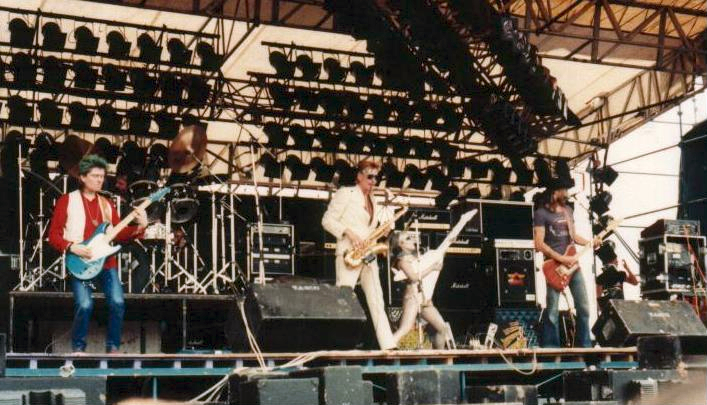
Gong are a rock band associated with the Canterbury scene. They incorporate elements of psychedelic rock, jazz and space rock into their musical style. The group was formed in Paris in 1967 by Australian musician Daevid Allen and English vocalist Gilli Smyth. Band members have included Didier Malherbe, Pip Pyle, Steve Hillage, Mike Howlett, Tim Blake, Pierre Moerlen, Bill Laswell and Theo Travis. Others who have played on stage with Gong include Don Cherry, Chris Cutler, Bill Bruford, Brian Davison, Dave Stewart and Tatsuya Yoshida.
Gong's 1970 debut album, Magick Brother, featured a psychedelic rock sound. By the following year, the second album, Camembert Electrique, featured the more progressive rock/space rock sound with which they would be most associated. Between 1973 and 1974, Gong released their best-known work, the allegorical Radio Gnome Invisible trilogy, consisting of Flying Teapot (1973), Angel's Egg (1973) and You (1974), which details the adventures of Zero the Hero, the Good Witch Yoni and the Pot Head Pixies from the Planet Gong.
In 1975, Allen and Smyth left the band, which continued without them, releasing the Howlett-fronted Shamal (1976) and a series of jazz rock albums under the leadership of drummer Pierre Moerlen. This incarnation soon became known as Pierre Moerlen's Gong. Meanwhile, Smyth formed Mother Gong while Allen initiated a series of spin-off groups, including Planet Gong, New York Gong and Gongmaison, before returning to lead Gong once again in 1990 until his death in 2015. With Allen's encouragement, the band decided to continue as a quintet comprising guitarist Fabio Golfetti, bassist Dave Sturt, woodwind player Ian East, guitarist and vocalist Kavus Torabi, and drummer Cheb Nettles. They released the album Rejoice! I'm Dead! in September 2016, followed by the loose trilogy of albums The Universe Also Collapses (2019), Unending Ascending (2023), and Bright Spirit (2026).
From Wikipedia, CC BY-SA 4.0.
Also in Français
Gong est un groupe de rock progressif international, originaire de Paris, en France. Le groupe incorpore des éléments de jazz et space rock à sa musique. Il est formé par le musicien australien Daevid Allen, qui a d'abord joué avec le Daevid Allen Trio en 1963 (formé de Hugh Hopper à la basse et Robert Wyatt à la batterie) puis avec Soft Machine en 1966, qu'il quitte en 1967 à la suite d'un exil forcé en France. La première formation de Gong en 1967, comprend Allen (chant, guitare), Gilli Smyth (chant, chœurs) et Didier Malherbe (flûte, saxophone) auquel s'ajoute le batteur éphémère Rachid Houari en 1969. Le guitariste Steve Hillage rejoindra la formation à géométrie variable en 1972.
Le premier album, Magick Brother de Gong, se caractérise par un son pop psychédélique. En 1971, sort l'album Camembert électrique, qui se caractérise par un son plus rock psychédélique/space rock auquel le groupe sera souvent associé par la suite.
En 1975, Allen et Smyth quittent le groupe, qui continuera sans eux en publiant plusieurs albums de jazz rock sous la houlette du batteur Pierre Moerlen. Cette incarnation sera connue sous le nom de Pierre Moerlen's Gong. Entretemps, Smyth forme Mother Gong et Allen inaugure une série de groupes dérivés comme Planet Gong, New York Gong et Gongmaison, avant de revenir aux manettes de Gong en 1990 et ce jusqu'à son décès en 2015. Avec les encouragements d'Allen, le groupe décide de continuer publiant l'album Rejoice! I'm Dead! en septembre 2016.
Wikipedia, CC BY-SA 4.0
Discography
Albums
- 1970 Magick Brother
- 1971 Camembert électrique
- 1973 Flying Teapot: Radio Gnome Invisible, Part 1
- 1973 Angel’s Egg: Radio Gnome Invisible, Part 2
- 1974 You: Radio Gnome Invisible, Part 3
- 1975 Shamal
- 1976 Gazeuse!
- 1978 Expresso II
- 1992 Je ne fum’ pas des bananes
- 1992 Shapeshifter
- 2000 Zero to Infinity
- 2001 Absolutely The Best of Gong
Show all (19)
- 2004 Acid Motherhood
- 2009 2032
- 2014 I See You
- 2016 Rejoice! I’m Dead!
- 2019 The Universe Also Collapses
- 2023 Unending Ascending
- 2026 Bright Spirit